
Evidence-based Health Care Quality Improvement Project &
Clinical Practice Guideline—Kaiser Permanente Hawaii: Venous Thromboembolism (VTE) Prevention Project
The EBM Information Quest: Is it true? Is it useful? Is it usable?™
Delfini Co-founders: Michael E Stuart MD, President & Medical Director . Sheri Ann Strite, Managing Director & Principal

Why Critical Appraisal Matters





 DelfiniClick™Evidence & Quality Improvement Commentaries |
Follow & Share...
Just-in-time Updates
Like Us  Find Us
Page Menu........
Venous Thromboembolism Guideline Materials are posted with permission from Kaiser Permanente Hawaii and Delfini Group. Selected components of guideline documentation are available from Delfini upon request.
- VTE/DVT Prophylaxis for Total Knee/Hip Surgery Guideline Recommendations
- VTE/DVT Prophylaxis for Total Knee/Hip Surgery - Clinician 1-Pager
- VTE/DVT Prophylaxis for Total Knee/Hip Surgery - Patient Messaging Script [PDF] & [WORD]
- Also from the Agency for Healthcare Research & Quality, general information for patients about blood thinners.
DelfiniGram™: GET ON OUR UPDATE LIST 
Kaiser Permanente Hawaii (KPHI): Prevention of Venous Thromboemobolism (VTE) in Total Hip and Total Knee Replacement

Mission: Help advance evidence- and value-based medicine in an organization that has already proved a demonstrated commitment to evidence- and value-based care by dedicating resources to EBM training and support and that now seeks to progress to an even higher level in skill, depth, application and cultural transformation.
Concept: Identify a clinical group that has ideas for a successful evidence-based clinical improvement project and provide them with training and support. Learnings will be applicable to other projects, plus team members will be able to facilitate similar projects with other clinical groups within the care system.
Delfini Role: Provide training, facilitation and support to the team to conduct the project and to effect both clinical and evidence-based process change.
At VTE Project

Menu........
Use of our website implies agreement to our Notices. Citations for references available upon request.
Home
Best of Delfini
What's New
Blog
Seminars
Services
Delfini Group Publishing
Resources
Sample Projects
Notices
About
Us & Our Work
Testimonials
Other
Site Search
Contact
Info/Updates
........
Quick Navigator to Selected Resources
- Tools & Educational Library
- The Healthcare Information Problem
- Tutorials
- DelfiniClick™—commentaries
- On the Same Page™—patient decision support
- Evidence Messaging Scripts
- Delfini Publications
- Medical Leader Interviews
- Glossary
- Recommended Reading
- Recommended Web Links
- Delfini Critical Appraisal Flier
- Get DelfiniGram™ Updates
.......................
Update: What’s New In Venous Thromboembolism (VTE) Prophylaxis For Total Hip and Total Knee Replacement Surgery 2009
In the summer of 2008, a group of KPHI clinicians and other stakeholders (orthopedists, hospitalists, pharmacists, nurses, facilitators, CME and EBM specialists) formed a working group—the KPHI VTE Prevention Guideline Team—along with Delfini to address the significant uncertainty about the following key questions:
- What is the evidence that thromboembolism or deep vein thrombosis (DVT) prophylaxis with various agents reduces mortality and clinically significant morbidity in hip and knee replacement surgery?
- What is the evidence
regarding timing of anticoagulant prophylaxis for appropriate agents
when used for prevention of thromboembolism in hip and knee replacement
surgery?
• What is the evidence regarding starting anticoagulant prophylaxis?
• What is the evidence regarding duration of anticoagulant prophylaxis? - What is the evidence regarding bleeding from thromboembolism prophylaxis with the various appropriate agents?
What We Learned and Recommend To Others
- The risk of VTE in total hip replacement (THR) and total knee replacement (TKR) surgery without VTE prophylaxis is frighteningly high with reported figures from 41% to 85%.
- The level of evidence (LOE) is fair for reduction of overall DVT rates with mechanical compression devices used in conjunction with recommended pharmacological agents; LOE is inconclusive for reduction of symptomatic DVT, proximal DVT and PE rates.
- Current national guidelines are conflicting and include evidence with significant threats to validity.
- With mechanical compression and pharmacological prophylaxis some studies report incidence rates of 10% to 15%.
- Based on our evidence
review and evidence synthesis the KPHI VTE Prevention Guideline Team
recommends that —
- Mechanical compression devices be used in conjunction with recommended pharmacological agents (enoxaparin, warfarin, fondaparinux or aspirin).
- Both compression devices and recommended pharmacological agents be continued at least through discharge, to achieve the lowest possible DVT rates in THR and TKR surgery.
- Until further evidence is available, decisions regarding the extension of VTE prophylaxis beyond hospitalization be individualized following risk assessment.
- Aspirin alone not be used as VTE prophylaxis in THR and TKR surgery because there is fair evidence that aspirin alone is not effective in preventing VTE and in one study the DVT rate was 47%.
Details regarding specific mechanical devices, drugs, bleeding risks, the quality of the evidence, dosing, etc. are available immediately below.
Read the interview with medical leader, Karen Ching MD, about how to make such evidence-based quality improvement projects successful

Phase I: Identify Team
.........
Leaders from Medical Education and the EBM Working Group solicited
interest among clinical staff. With Delfini's guidance, a multidisciplinary
team was formed including orthopedic surgeons, a vascular surgeon,
hospitalists, pharmacy, nursing and an EBM working group leader.
Phase II: Select Project
.........
Delfini provided advice and training in successful project selection.
Total knee and total hip replacement surgery was identified as a topical
focus area. The team agreed upon development and implementation of
a clinical practice guideline as their EBM clinical improvement project.
Phase
III: Develop Project Outline
.........
Existing guidelines were reviewed for applicability, validity, appropriateness
and currency. A focus statement was created.
Focus statement:
7/25/08
"A standardized, evidence based DVT prophylaxis protocol for
the known high risk total knee and hip replacement population."
Key issues
Focus on prophylaxis for joint replacement surgery
- Bleeding risk from pharmacologic prophylaxis
- Duration of therapy for anticoagulant prophylaxis
- When to start. Role of preoperative prophylaxis
Key Questions
Clinical Questions Addressed in this QI Project
1. What is the evidence that thromboembolism or DVT prophylaxis
with various agents reduces mortality and clinically significant
morbidity in hip and knee replacement surgery?
2. What is the evidence regarding timing of anticoagulant prophylaxis
for appropriate agents when used for prevention of thromboembolism
in hip and knee replacement surgery?
— What is the evidence regarding starting anticoagulant prophylaxis?
— What is the evidence regarding duration of anticoagulant
prophylaxis?
3. What is the evidence regarding bleeding from thromboembolism
prophylaxis with the various appropriate agents?
Phase IV: Obtain, Evaluate & Synthesize Evidence & Phase V: Create Clinical Recommendations
.........
Existing guidelines and relevant systematic reviews were audited
to see if they passed a critical appraisal screen. (They did not.)
Potentially useful evidence was obtained through a systematic search and filtering process using titles and abstracts. Following filtering, the potentially best available valid and useful evidence was identified and readied for critical appraisal.
Team members received training in effective searching of the medical literature, critical appraisal for validity and clinical usefulness of primary and secondary sources, measures of outcomes, effective use of confidence intervals, evidence grading and more.
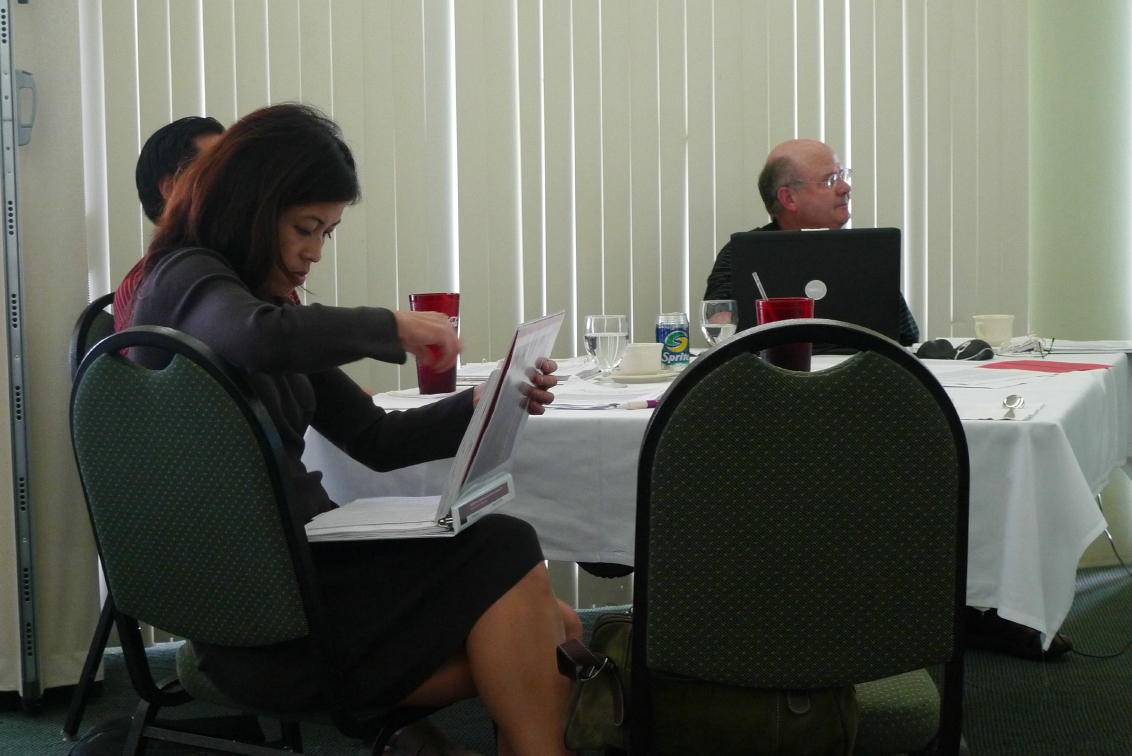
Members
of the KPHI VTE Quality Improvement Project & Guideline Team:
Pictured are
Lynn Wardwell PharmD & Mike Stuart MD, Delfini Facilitator.
(Hiding behind Lynn is Rob Shin, MD, Orthopedic Surgeon.) Also hiding
besides other team members is Sheri, Delfini facilitator,typing
frantically, trying to keep up with the brilliant team as they craft
draft clinical DVT recommendations.
In 2 two-day on-site working sessions, team members accomplished the following —
- Critical Appraisals
- Evidence Syntheses
- Clinical Recommendations
Process
Multi-disciplinary teams of 2-3 conducted 34 critical appraisals
for validity and clinical usefulness on-site during these 2 two-day
training and working sessions. Team members could engage others
or request participation of the entire 11 member team participants.
Following appraisal, the team recorded key details of passing studies,
created evidence statements for each study, synthesized the evidence
from these statements and then crafted clinical recommendations
to form the basis of the guideline.
Keys to Success
- Delfini-conducted searches
- Effective (and appropriate) use of secondary studies and sources
- Team participating in filtering
- Effective training
- Prepared templates and tools
- Multi-disciplinary teams — each team had representation of expertise in VTE/DVT management, pharmacy and EBM practice at a minimum
- Computer entry using
a streamlined critical appraisal and study detail capture system
- Initial modeling with full group participation for several appraisals
- Online access to confidence interval calculators, printers, etc
- Pre-assignment of selected studies
- Rules encouraging free engagement
- Group reporting of passing studies and discussion
- Consensus building methods to address controversies
- Examples to inspire group reaction
- Process "tricks" to facilitate group engagement in a complex process — example 1: color coding to separate draft from completed work, example 2: visual and oral transitions during synthesis...more! (Might not sound very meaningful right now, but process tricks helped a heap!)
- Just-in-time documentation capture
Phase VI: Assess Impacts of Practice Change
.........
Not done for this project.
Phase VII: Create information, Decision & Action Aids
.........
- VTE/DVT Prophylaxis for Total Knee/Hip Surgery Guideline Recommendations
- VTE/DVT Prophylaxis for Total Knee/Hip Surgery - Clinician 1-Pager
- VTE/DVT Prophylaxis for Total Knee/Hip Surgery - Patient Messaging Script [PDF] & [WORD]
Phase VIII: Implement Guideline
.........
Ongoing
Phase IX: Implement Measurement & Reporting Plan
.........
Ongoing
Phase X: Continuous Improvement
.........
Ongoing


Return to Top
© 2002-2020 Delfini Group, LLC. All Rights Reserved Worldwide.
Dolphin photo for Dolphins Poolside attributed to RevolverOcelo. Delfini
Boat thanks to Dr. Bat Shunatona.
Thanks too to contributors to such open source projects as openclipart.org and Wikimedia Commons.
Use of
this website implies your agreement to our Notices.
EBM Solutions for Evidence-based Health Care Quality